Q-1. What
is the net system efficiency from renewable energy to liquid
WindFuels?
The mid- term system efficiency should
be about 55% (HHV), and higher efficiency will eventually be
possible.
Q-2. How
expensive must oil be for WindFuels or CARMA to compete?
In some cases only $50/bbl. Read
more.
Q-3. How
does WindFuels solve the grid stability and energy storage
challenges?
The grid stability challenge arises
from changes in grid supply not being able to follow the changes
in grid demand quickly enough. Wind power is often greater
in the middle of the night when demand is minimal. “Clean coal” and
nuclear power plants take many hours to turn down, and with most of the good
sites for pumped hydropower already developed, there is no cost effective method
of storing energy. (See our 2010 ASME paper on Energy
Storage.)
WindFuels will only draw
power during off-peak hours when there is excess renewable
energy available at very
low cost. Off-peak power rates are often under
15% of peak rates to encourage more use of it. WindFuels can respond within
milliseconds to changes in supply and demand. It will completely
solve the grid stability
problem by temporarily storing the excess peak grid energy in hydrogen and
then converting the hydrogen into liquid fuels (which are
easily stored and distributed) at a
fairly steadier rate. See our Economics page
and our discussion on Stabilizing
the Renewable Grid for more information.
Q-4. How are WindFuels nearly 100% carbon neutral?
Absolutely no new fossil carbon is removed from the Earth. All the carbon comes
from the effluent CO2 from fossil-fueled power plants. All energy input is
from the cheapest renewable resource – off-peak wind.
Q-5. What
is CARMA, and what does it offer?
CARMA stands for CO2 Advanced Reforming of Methane Adiabatically.
CARMA offers a cheaper way to make standard fuels of all types (jet fuel, gasoline,
diesel…)
as long as natural gas is cheap.
The only valid objection that has been raised to WindFuels is that electrolyzers
are still rather expensive, and this would discourage investors. (Valid is the
operative word above. We address other questions further down this page and elsewhere.)
Even with current prices for electrolyzers and likely off-peak wind energy prices,
the Windfuels process can still produce carbon-neutral fuels for under $2.50/gal,
but there is a more competitive option as long as shale gas is cheap. Investors
just want to make money as quickly as possible without counting on any incentives
from the government for helping to slow global warming, so the CARMA process
is more attractive for the next decade.
The CARMA process combines some renewable hydrogen (from off-peak wind electrolysis)
with methane, CO2, and water in a synergistic way that provides dramatic
benefits
(reduced O&M costs and higher efficiency) in what is otherwise a rather conventional
Gas-to-Liquids (GTL) process. Conventional GTL releases enormous amounts of CO2.
That CO2 release is reduced or even eliminated in the CARMA process, depending
mostly on the ratio of hydrogen to methane.
The greater the H2/CH4 ratio, the “greener” the
fuels produced, but a greater benefit comes from the flexibility the process
affords in input choice.
The price of off-peak grid energy sees large fluctuations, and so does the price
of natural gas. The CARMA process allows the plant to operate at maximum efficiency
over an extremely wide range of input mixes as the markets change.
Over 90% of the input energy could initially come from shale gas, while eventually
the input energy could come totally from renewable hydrogen. The CARMA process
will be attractive to investors today, and it will begin to drive the electrolyzer
industry in the way needed to bring prices down from economies of scale so Windfuels
become even more competitive. Many more details are covered in our 2012-ACS paperand the Economics page.
Q-6. Well,
the coal’s
CO2 is eventually released into the atmosphere,
so how can WindFuels have a climate benefit?
That CO2 is being created and exhausted
anyway.
Almost no fossil power plants have CO2 sequestration,
so
their CO2 emissions
are a reality. Using
that CO2
to create fuels means the CO2 eventually gets exhausted, but those
fuels would offset the production of deep-water drilling, tar sands, oil shale,
and coal-to-liquids
fuels; all of which are far more carbon intensive and environmentally destructive
than “conventional” oil fuels.
Q-7. Why
is 50-60% efficiency something to get excited about?
First of all, WindFuels will beat any other renewable fuel in the market place
by a wide margin within 7 years. Secondly, it’s twice as good as any
expert thought likely before we showed what was possible.
Q-8. How
do you respond to old-timer “experts” who
say “Major breakthroughs in energy are impossible” ?
Scientific progress and creativity are hard to predict, but both happen. Who
would have predicted commercial jet travel in the 1940’s, or lasers in
the 1950’s, or cell phones in the 1970’s, or Blackberries in the
1980’s, or PV installed at under $4/W in the 1990’s?
“Necessity is the mother of invention.” The near-term need for WindFuels
wasn’t completely clear until about 2008.
A number of industries have demonstrated the kind of scale-up needed here. They
have had the same basic common denominators: high profitability, no resource
limitations on raw materials, and sufficient demand or rapidly escalating demand
to accommodate growth.
WindFuels will not require large numbers of highly skilled workers outside of
factory settings – as in nuclear energy. WindFuels will not require large
areas of land and a quintupling of the number of farmers – as in biofuels.
WindFuels will not require complex solid-phase separations – as in algae
oil and cellulosic ethanol. (One of the first rules in scalable chemical engineering
is to avoid solid-phase handling, separations, and processing.)
The RFTS plant is mostly based on the kinds of chemical engineering processes
that scaled up at lightning speed between the late-1930’s and the early-1960’s – and
transformed modern society.
About 70% of the subsystems and components needed (or very closely related components)
are currently in production at the multi-billion-dollar level by multiple, international
companies. And there are fairly close relatives of most of the rest of the components
currently in production at the multi-billion-dollar level.
Scale-up will require large investments, but they will come because there will
soon be no question about the profitability of the WindFuels plants. Scale-up
will also take time, mostly because big investments are seldom made quickly.
However, scale up of the processes used in Windfuels will be much easier than
those in algal oil, cellulosic ethanol, batteries, CSP, hydrogen, PV, geothermal,
superconducting transmission, .... Read
more.
Q-8. How
do you respond to old-timer “experts” who
say “Major breakthroughs in energy are impossible” ?
Scientific progress and creativity are
hard to predict, but both happen. Who would have predicted commercial
jet travel in the 1940’s, or lasers in
the 1950’s, or cell phones in the 1970’s, or Blackberries in the
1980’s, or PV installed at under $4/W in the 1990’s?
“Necessity is the mother of invention.” The near-term need for WindFuels
wasn’t completely clear until about three years ago.
A number of industries have demonstrated the kind of scale-up needed here. They
have had the same basic common denominators: high profitability, no resource
limitations on raw materials, and sufficient demand or rapidly escalating demand
to accommodate growth.
WindFuels will not require large numbers of highly skilled workers outside of
factory settings – as in nuclear energy. WindFuels will not require large
areas of land and a quintupling of the number of farmers – as in biofuels.
WindFuels will not require complex solid-phase separations – as in algae
oil and cellulosic ethanol. (One of the first rules in scalable chemical engineering
is to avoid solid-phase handling, separations, and processing.)
The RFTS plant is mostly based on the kinds of chemical engineering processes
that scaled up at lightning speed between the late-1930’s and the early-1960’s – and
transformed modern society.
About 70% of the subsystems and components needed (or very closely related components)
are currently in production at the multi-billion-dollar level by multiple, international
companies. And there are fairly close relatives of most of the rest of the components
currently in production at the multi-billion-dollar level.
Scale-up will require large investments, but they will come because there will
soon be no question about the profitability of the WindFuels plants. Scale-up
will also take time, mostly because big investments are seldom made quickly.
However, scale up of the processes used in Windfuels will be much easier than
those in algal oil, cellulosic ethanol, batteries, CSP, hydrogen, PV, geothermal,
superconducting transmission, .... Read
more.
Q-9. What
do you think about cellulosic ethanol?
Trees, shrubs, and grasses sequester
two orders of magnitude more carbon above the ground than is
being released annually by burning fossil fuels, and an
even greater amount is sequestered in soils. When forests are harvested for
cellulosic ethanol, about 20% of the above-ground carbon ends up in the ethanol.
(Much is left to decay rapidly on the forest floor. Most is emitted from the
cellulosic ethanol plant.)
When new land is tilled, much of the carbon that has been sequestered
in the soil for centuries is released over the next few
years. This “carbon debt” can take more than a century for the
biofuels to repay.
The 16 million acres of wildfires in the U.S. in the past two
years (2011-2012) has become “the new normal”, largely because of land warming – which
is much more serious than global warming. The “food baskets” of
the world will be producing less in the future because of “dust bowlification”.
There will not be excess productive land available in the future for growing
fuels, irrespective of whether or not they seem to be competing directly with
food.
Grasslands predominate naturally in regions where rainfall
is inadequate to support forests. “Range Fuels” may be a catchy
name, but any attempt to produce cellulosic ethanol from most range land will
result in a huge release of sequestered carbon and not enough energy to matter. Read
more on our Economics page.
Q-10. How
can WindFuels compete with tar sands?
Products from heavy oil (such as
the tar sands in Alberta) have 60% to 90%
greater total carbon emissions than conventional oil and a huge environmental
footprint (orders of magnitude greater than that of oil platforms in ANWR).
Processing heavy oil requires an enormous amount of natural gas. Tar sands
and extra heavy oils (from Venezuela) are abundant, but utilizing them will
become very expensive as emissions regulations (to save the planet) become
more stringent. The IEA says we need a $50-$60/bbl tax on heavy oil products
to have any chance of cutting carbon emissions in half by 2050. WindFuels
could be cheaper than heavy-oil products within 5 years.
Q-11. Why
does the DOE still not admit to Peak Oil?
Actually, they now do. It’s just some sections of the media that haven’t
gotten with the program.
Q-12. Wouldn’t
it be better to just replace coal power plants with wind?
Perhaps, if (a) there was a cheap
method of storing the energy for when it was needed, (b)
there was an adequate transmission grid, and (c) someone
would
pay for all the wind farms. All of these are show-stoppers beyond a certain
point. We agree: put as much wind into the grid as the market will justify,
and use the excess off-peak wind to make transportation fuels.
(If you’re not
a scientist or engineer, you might want to skip this next
one.)
Q-13. How
would you boil down your major technical breakthroughs
into a few sentences for the general chemical engineer?
To start with, we’ve doubled the
efficiency of producing syngas (the feed mixture of CO
and H2) from H2 and
CO2 by making the RWGS reaction
practical. (This requires, among other things, a dramatic
advance in cost-effectiveness of gas-to-gas recuperators.) Secondly, we’ve
reduced both the energy and effluent losses normally seen in recycling of un-reacted
reactants and byproducts in high-pressure FTS processes by an order of magnitude.
(This takes too much space to explain further here.) Thirdly, we’ve nearly
eliminated the big losses normally seen from isenthalpic expansions in the
standard product separations processes. Fourthly, we’ve improved by 50%
the efficiency of conversion of low- and mid-grade waste heat to electrical
power. See the DORC patent.)
Q-14. How
does Doty Windfuels expect to make money?
Here’s our vision in a nutshell.
The world’s appetite for transportation fuels will steadily
grow at a rate greater than can be met by conventional fossil
fuels and alternatives, so the
price of oil will rise steadily until a competitive alternative becomes available.
There is currently no competitive alternative. We will be able to make fuels
from CO2 and H2O at a much lower price than any other sustainable
alternative. Windfuels will be carbon neutral, so the public will embrace them.
We have a very strong patent and proprietary position, as well as an enormous
head start. We will probably have no serious competition for at least a decade.
We first need to build a small pilot plant. When it starts producing fuels (two
years after funding) we will demonstrate production of more fuels
in a few weeks than the total cumulative global production of photosynthetic
algal oil and direct solar fuels combined. That comparison will generate enormous
media attention, and investors will be beating a path to our doors.
We will begin producing and selling small plants that will make fuels from
CO2, CH4, H2Oand off-peak wind energy. No one else will
be able to
do that,
so we will
be able to command strong profit margins on these plants.
The payback on the Windfuels plants will be under 3 years. There will be hundreds
of thousands of wind farm owners all over the world standing in line to buy them,
as fast
as we can make them.
We expect be a multi-billion-dollar company 7 years after first funding, and
growth will go on from there. The market for the Windfuels plants we’ll
be making will eventually be trillions of dollars.
Q-15. Do
you have a working demonstration?
Not yet, but we have a lot of preliminary
experimental data, and more will be coming quickly. We
have developed the necessary innovations, and within the
past we have year simulated the plant in great detail
(through secondary separations) using
commercially available
chemical engineering process software. These simulations
confirmed that are earlier manual-analytical approach was
spot-on. However, we are a small company with a limited
R&D budget. The demonstration
plant that is planned will require additional funding.
Q-16. How
certain are you that your simulations are correct?
The WinSim Design II software has
been well validated in thousands of similar simulations
in the
petrochemical and chemical process industries over the
past
two decades. We’ve collaborated with outside experts in the field during
our entire research and development process.
We waited to release
the information until enough time had passed that we could
be comfortable
with
our patent
positions. So we have released more information in greater detail
than any other alternative energy company we’ve ever seen.
Many design details and calculations are available
for any and all members of the scientific community to assess
and critique, and at this
point our designs have been thoroughly scrutinized by thousands
of interested scientists and engineers. No one has yet found
a significant error or oversight. Naturally, we have hundreds
of pages of additional detail that is proprietary. Much of this
too has been reviewed by outside experts. (Some critics described
perceived problems, but none of their technical challenges have
proven to be valid.)
Q-17. Chemical
processing plants have a reputation for being dirty. Won’t
the same apply to WindFuels plants?
The inputs to the WindFuels process
don’t contain noxious contaminants
as seen in fossil fuels (especially in heavy oils). For example, the sulfur and
heavy metals contents will be at least 10,000 times lower. That, along with the
numerous process advances, make 100% recycling practical. Emissions will be similar
to those seen at major highway junctions.
Q-18. Have you published
WindFuels papers in peer-reviewed journals?
We’ve
published eight peer-reviewed technical papers and given a number of presentations
at international scientific conferences. Read
more...
Q-19. Why not just stop with
your hydrogen production from off-peak wind energy and use it
in fuel cells?
One of the main reasons hydrogen will not be
used in much of the transport sector is that the density of
energy storage in
hydrogen
is less
than 10% that in jet fuel
or gasoline. (Hydrogen storage tanks must be very large and heavy.)
Few informed people today think there is any
another plausible long-range alternative
than sustainable,
carbon-neutral,
liquid-hydrocarbon
fuels for air,
rail, ship, and truck transport – nor for a large fraction of private transportation.
After a decade of intensive development, fuel cells are still ten times more
expensive than internal combustion engines.
Q-20. Are there any limitations
to the types of chemicals that can be made from WindFuels?
Not really. Some of the products coming directly from the FTS process will
be ethylene, propylene, and methanol, which today serve as the basic building
blocks
for most chemicals. Of course, some other inputs will sometimes be required
(like nitrogen, salt, etc.), but the point is that fossil fuels are not essential
for
any chemicals.
Q-21. What do you intend to do next at
Doty Windfuels?
Proceed with experiments and demonstrations as expeditiously as possible. We
expect to be producing WindFuels plants and selling them to wind farm
owners within five years. Ultimately, we intend to license the WindFuels technology
to all qualified, interested companies at reasonable fees. Read more.
Q-22. Won’t it be extremely
costly and
difficult to build long CO2 pipelines from the coal power plants
in Pennsylvania
and Ohio
to the wind farms in Texas,
the Dakotas, and other high-wind states?
There’s plenty of CO2 produced in the high-wind
states: The most wind-blessed states are the Dakotas, Montana, Wyoming, and Kansas.
All of these states have
at least 80% of their power derived from coal, and there are lots of bio-ethanol
plants being built there, which release enormous amounts of CO2.
But that is not all the wind that is available in the U.S. There are
also other excellent wind resources throughout America. For instance: the major
industrial regions of Western New York, Western Pennsylvania, Northeast Ohio,
Northwest Indiana,
Northeast Illinois, Eastern Wisconsin, and all of Michigan are all within 200
miles of the extraordinary winds available on the great lakes. This
map from
the DOE shows the projected wind potential at 50m across America.
The amount
of CO2 being released from point sources in the U.S. (coal
power plants, cement factories, ammonia plants, biofuels refineries,
other industrial sources) is sufficient to make twice as much
transportation fuel as we currently consume.
It will not be difficult or costly to transmit electrical power
a few hundred miles from wind farms to the RFTS plants, and
it will not be difficult to lay
CO2 pipelines a few hundred miles long (at least if they don’t
cross more than one state border). The total amount of coal currently consumed
within 350
miles of high-wind areas in the U.S. (and not requiring more than one state border
crossing) is about 400 million tons per year. The coal and gas power plants
in
these
areas
generate
enough CO2 to make nearly half the transportation fuels consumed in
the U.S.
Longer CO2 pipelines and power lines would eventually be needed,
but
work on the CO2 pipeline infrastructure
is already underway for enhanced
oil
recovery– and eventually for sequestration. Over 3500 miles of CO2 pipelines
have already been built, and the CO2 is
currently available from them at over 120 bar, 97% purity, for only $30/ton.
Further purification to the level needed
for the RFTS plant will add under $15/ton. See the pages under Economics for
more information on the CO2 market.
Q-23. How do the water demands for WindFuels
compare to those for biofuels and nuclear?
At least an order of magnitude less. The WindFuels plant design
simulations have assumed dry cooling. It should also be noted that reverse-osmosis
(water purification)
processes have become much cheaper in the past six years, and they’ll get
cheaper yet over the next six years.
Q-24. Most of the world is not blessed with
good wind resources. How realistic will it be for Concentrated
Solar Power (CSP), nuclear, and
Geo-thermal to make renewable liquid fuels using your RFTS process in places
like India,
China,
Africa,
and
Iceland?
Glad you asked. CSP and
enhanced geo-thermal still have a long ways to go before it will be practical
for them to compete with wind in a Class-4 (or better) wind site, but progress
is being made. We’ve shown that a substantial improvement in thermal conversion
efficiency will be possible where both good geo-thermal and CSP resources are
available fairly close together – within about 20 miles of each other.
More details on this can be found in our DORC ASME
paper.
There is another possibility, called dry reforming, for making liquid fuels using
CO2, methane, and high-temperature CSP. Our analysis shows it won’t
compete with WindFuels in North America, but it might eventually make sense in
some countries.
Nuclear energy can be used if nuclear power plants can be built at affordable
prices. Energy from new nuclear power plants in the U.S. will be 2-6 times more
expensive than off-peak wind for at least the next decade.
Q-25. What do you see as the greatest challenges
in making WindFuels a reality?
The “not invented here” attitude at many institutions
may limit their enthusiasm. Most Green Tech research and funding institutions
have already fully committed their resources and focus to what seemed to be the
best alternatives a few years ago. In spite of the fact that biofuels can only
supply a small percentage of the world's fuels, the biofuels community may be
very reluctant
to admit that there is a better alternative.
The DOE seems
reluctant to acknowledge the
spiraling costs
of nuclear, microalgae, shale oil, cellulosic ethanol, sequestration, coal, and
CTL;
and
some
at
the DOE will have a hard time admitting the “Hydrogen Program” needs
to be re-directed to a “WindFuels” program.
Most energy scientists and
engineers focus very narrowly on one particular aspect of a particular
resource or alternative. Very few are comfortable doing system-level
analyses of complex chemical plants, and few are willing
to support anything that has not yet been advocated by high-level
officials at the DOE.
There hasn’t been a
new oil refinery built in the US in over 30 years, so there are
very few chemical engineering programs with the expertise needed
in novel, complex plant simulations to provide the kind of support
needed quickly.
Q-26. What
size of a global investment are you talking about to cut global
oil and gas usage by 60% over the next 50 years?
The near-term (2 to 10 years) investment would be quite modest,
as there will be no shortage of off-peak wind energy for the
next decade. However, to replace
60% of global oil and gas with WindFuels over the next 50 years will cost
trillions of dollars, but businesses will embrace it because it will be profitable
and enduring. The IEA has recommended CO2 be
taxed at over $80/ton (or $300/ton-C). That would amount to $2T
per year – and it
(in itself) would not produce any more fuel. That would also amount to a tax
of $30/bbl for conventional oil. For synfuels from heavy oil and coal, the tax
would
be
over $50/bbl and $60/bbl respectively with current processes.
Q-27. How much of your process is commercially
proven, and how much is high risk?
We’ve simulated all the critical processes in WindFuels in great detail
using commercial, well validated software. Fischer-Tropsch Synthesis (FTS) fuel
production (chemically, the most complex part of the WindFuels system) was used
by the Germans during WW-II and in South Africa during the blockade of the Apartheid
regime. Several major breakthroughs and a number of minor improvements have allowed
us to double the RFTS system efficiency over what was seen in related demonstrations
a few years ago. We’ve published and patented many of the critical scientific
and
engineering
details. We don’t think any part of it classifies as “high
risk” from a scientific perspective, though we admit there are managerial,
funding, competitive, technological, and market risks.
Q-28. You’re starting with water electrolysis.
Isn’t that very inefficient and extremely expensive?
Commercially available electrolyzers have achieved 84% efficiency,
and laboratory experiments have exceeded 94% efficiency.
Yes,
they’ve
been expensive, but the DOE projects their price will drop by a factor of six
over the next decade and efficiencies will steadily improve. Read
more.
Recognizing the initial
capital cost of the electrolyzers might be a deterrent, we have
developed
a bridging technology we call CARMA,
as discussed earlier under question 5.
This will process takes advantage of the currently low natural
gas prices to make the initial fuels
(although not fully carbon neutral) more cost competitive. The
goal is to include some natural gas in the Windfuels
FTS system. As the price of natural gas goes up, more electrolyzers
will be added to supply renewable hydrogen. The expectation is
that the fuels will eventually be fully carbon neutral.
Q-29. Are
WindFuels better than CO2 sequestration?
WindFuels will be the quickest technology to stop the growth
of coal power plants because of the strong stimulus WindFuels
will provide to the growth of wind energy. The wind energy
during periods of peak demand will go to the grid, and
excess during off-peak periods would go to WindFuels. We
have
already seen that wind energy has stopped the growth
of coal in the U.S. and northern Europe. When WindFuels
come online in any country, the growth of coal in that
country will come to an abrupt end. The price of grid energy
will even drop enough to begin shutting down the less efficient
coal power plants. The wind resources are sufficient to
enable this scenario in North America, China, Russia,
Northern Europe, Northwestern Africa, Australia, Brazil,
and some other countries.
Sequestration, on the other hand, at existing power plants will be very expensive.
It would increase consumer power bills by 60-80% in many cases and
reduce the efficiency and output of coal and natural gas power plants, requiring
more fossil power plants by 30-40% to come online. Recent
peer-reviewed studies have shown that pumping very high pressure CO2 into
most of the types of formations that could hold it for centuries will likely
cause seismic activity.
WindFuels, on the other
hand, will cause no additional burden for consumers, and actually serve to
make current
power sources more competitive, so there will be no public resistance to
their development. Since WindFuels will be market driven, they will grow
as quickly as the industry can scale up, and any support from government
will be embraced by the power industry and consumers.
Because WindFuels will be
market driven, it can quickly cut the use of ultra-high-carbon
options, such as coal-to-liquids, tar sands, and shale oil – which,
without WindFuels, would be supplying a large fraction of our
transportation fuels within 20 years.
WindFuels could eventually
utilize CO2 from the atmosphere rather
than from power plants, but it may be three decades before taking
CO2 from
the atmosphere is affordable. (We return to this issue in more
detail in question 36.)
We agree that CO2 separation
should be required on all new power plants, whether coal, natural
gas, or biomass; and retrofitting should be implemented on some
existing power plants. The CO2 should
be either sold to WindFuels plants or sequestered. CO2 separation
processes will now be justified on many existing coal plants
within 400 miles of WindFuels plants because there may
be a good market for their CO2. Also,
future fossil-fueled power plants within 400 miles of WindFuels
plants may want to
buy the waste O2 from the WindFuels
plants for oxy-combustion to simplify their CO2 separations.
The fastest growing source
of CO2 emissions in the U.S., Brazil,
and some other countries is from bio-ethanol production. The
amount (mass) of CO2 released
at the process plant making ethanol from corn is similar to the
amount of ethanol produced. The amount of CO2 released
when making cellulosic ethanol is more than twice the amount
of ethanol produced.
Separation of this CO2 from the exhaust
streams is much easier than in existing power plants, and the
penalty in plant efficiency
is much less. Hence, CO2 separations
should begin with bio-ethanol plants and new fossil-fuel power
plants. The current global CO2 release
from bio-ethanol plants is over 60 million metric tons per year
and growing rapidly. Emissions from bio-ethanol will
likely be more than will be practical to sequester and utilize
in WindFuels for at least the next 15 years.
The $100M spent by the coal
lobby over the past few year has convinced many consumers that “clean
coal” is a reality. The fact is, the total amount of CO2 sequestered
from coal plants in the US by 2015 is likely to be less than
0.04% of the amount of CO2 they’ll
release.
The DOE has announced
funding for three big carbon capture projects that were expected
to begin operating in 2012. The total cost of these projects
will be $1B, with over 60% coming from the DOE. These projects
are
expected to be capturing CO2 at a combined rate of
about 6.5 Mt/yr by 2013. The projects selected for funding were
low-hanging
fruit – an ethanol plant, a methanol plant, and a steam-methane
reformer – no power plants. The captured CO2 will
be used for enhanced oil recovery (EOR) – which means it
is not being sequestered – its half-life in the ground
is only 15 years. The CapEx for this capture is not very high – only
about $10/t-CO2. The operating cost is under $25/t-CO2.
For comparison, the CapEx for real CO2 sequestration
projects using CO2 from
power plants and pumping the CO2 into formations that
will hold it for centuries is about $30/t-CO2, and
their operating cost
is about $40/t-CO2. At $70/t-CO2, sequestering
the emissions from point sources would represent an enormous
economic
burden – about
$300B dollars per year in the U.S.
WindFuels can provide the market needed
to make CO2 separation happen quickly,
and WindFuels can stop the growth of tar sands. This would
dramatically reduce CO2 emissions.
All sequestration ideas make the energy challenge worse, while
WindFuels will address both the energy and the climate
challenges. Oil and gas account for over
60% of the global fossil CO2 emissions.Replacing
petroleum and natural gas with WindFuelsTM reduces
greenhouse gases more than eliminating coal. Neither will
happen quickly,
but
we have to think long range. Read
more.
Q-30. I’ve
taken a close look at your cost estimates for WindFuels,
and they look low?
Can you explain briefly?
We’re glad you’re checking
us. Yes, at first glance it might look like our estimates of
the
cost of wind energy are too low. First of all, keep in mind
that for the next 12 years or more there will be an abundance
of very cheap off-peak grid power in areas where a lot of wind
farms are being built. WindFuels will be providing a market for
this off-peak energy and thus providing a strong stimulus to
the wind energy market. See our Economics
page and our discussion
on Stabilizing
the Renewable Grid for more information.
The simplest industrial reference point is to note that the capital
cost in recent GTL plants contributes about $0.20/gal to the
cost of the fuels produced. Of course, our CARMA plants will
be much smaller, so capital costs per gallon will be somewhat
higher, but we have a number of innovations at various stages
of the patenting
process that will dramatically reduce the costs
of the CARMA plant.
More details can be found in the papers presented
at recent ASME and ACS conferences, though of course many details remain proprietary.
Q-31. Will
WindFuels compete with Coal-to-Liquids (CTL)?
Yes. Synfuels from Coal-to-Liquids (CTL)
currently have twice the carbon emissions of conventional oil. Typically,
one kilogram of coal will yield about 0.3 kg of diesel and 2.2 kg of additional
CO2, which is released at the synfuels plant. Sasol (the biggest
name in CTL) is the largest point source of CO2 emissions in the
world.
The latest published
studies we’ve seen
indicate oil needs to be above $100/bbl for CTL with partial
on-site sequestration (perhaps 65%) to compete. Those estimates
are still dated and hence optimistic. We expect oil
will need to be above $170/bbl for CTL with full sequestration
to compete a decade from now. Any estimate of energy-related
costs published before the BP oil-rig disaster on April 20, 2010
is probably of very little value. Judging from the recent volatility
in
commodities
markets,
it
may be another year before it will be possible to make
many energy cost projections with accuracy better than 25%.
The best recent study we’ve seen on future oil prices
is one from 5/2012 by the International Monetary Fund projecting
the price of oil in current real dollars will be $180/bbl
in 2022.
Q-32. T. Boone
Pickens wants to replace our natural gas electric power with
wind power and
convert our cars to run on compressed
natural gas (CNG). Could that work?
You aren’t going to convince the
companies that own the natural gas (NG) power plants to power
down their plants prematurely unless the price of NG triples.
Even with the increased availability of shale gas, we would see the price of
gas in the U.S. increase quickly if we tried to use it for more
than a very small segment of transportation (such as airport
buses). Until WindFuels plants begin to come online, the growth
rate of utilization of
wind
in the grid will
be limited by transmission and storage costs.
There are a number of additional factors.
1. There
won’t be much
fuel-cost savings for CNG vehicles 8 yearsfrom now.
(The rapidly growing
international trade in liquefied natural gas, LNG,
will entice US producers to begin exporting LNG to this lucrative market. This
will drive the price of NG up.)
2. Upgrading existing gasoline service stations to be able to re-fuel CNG vehicles
would cost about $400K per station. Few station owners will do this just to service
a few CNG vehicles in their area.
3. CNG vehicles have lower performance, less driving range,
and less trunk space,than liquid-fueled vehicles, so consumers will be reluctant
to buy them. (Of course, CNG vehicles would be much more attractive to most
consumers than electric vehicles or hydrogen-fueled vehicles.)
CNG has made small inroads into
fleets of trucks and buses in the U.S, where their ranges stay
close to central
re-fueling
stations. Encouraging more usage here makes sense. However,
converting all our long-haul trucks to CNG would increase our
use of NG by 25%, which would require an unrealistic increase
in domestic production.
US NG resources are nothing close to limitless, as the advocates
would have us to believe. The latest official estimates indicate
that if we could recover all possible and probable gas resources
(most of which will be quite expensive), they would be sufficient
to supply all our energy demands for about 15 years – and
nothing beyond that. Another useful number is that total U.S.
resources are less than 4% of global gas resources.
WindFuels, on the other hand, by offering improved profitability for wind energy
in areas far from where grid power is needed, will enable massive growth in
wind for decades. But wind will not shut down existing natural-gas power plants
in a free market for many years.
The amount of energy potentially available from domestic wind resources over
the next century exceeds that from natural gas by a factor of 50, and wind
is 20 times cleaner!
Case closed.
Q-33. What
about electric vehicles (EVs), or plug-in
hybrid electric vehicles (PHEVs)?
Pure electric vehicles will never be
the first choice for most consumers in the Western Hemisphere
as a primary vehicle due to their range restrictions. With pure
EV,
traffic
jams and unexpected errands
will result in more cars running out of power. A 40-mile range is not
acceptable for most drivers. (Remember, you simply can’t stop in somewhere
for a quick recharge.)
The Volt is a small compact car,
costing over $40,000. Whether the reduced operating costs can
ever actually recover the up-front cost is questionable, especially once you
factor
in additional interest on the more expensive car. A study
by Carnegie Mellon severely challenged the viability of the Chevy Volt.
The cost savings per mile are much less than the EV advocates claim, as they
still often assume an electricity cost of $0.04/kWhr when the current average
residential rate is $0.12/kWh (equivalent to gasoline at $1.20/gal).
If you drive the Volt 8500 miles
per year (and you won’t be able to drive it much more than that without
being left stranded), and gasoline is $4.70/gal, your annual fuel savings is
$700.
John Peterson has some of the best expertise and
insights into the battery and EV markets. We highly recommend
his articles, which are available here: http://seekingalpha.com/author/john-petersen/articles
Q-34. Why
do you want to make diesel and gasoline, when it’s
easier to make methanol from CO2 and H2 ?
The strongest argument is the economic one. Because it’s easy to make methanol
from coal or natural gas, methanol is the cheapest fuel available. However, it’s
not a good fuel because of its low energy density, high toxicity, high vapor
pressure, and high corrosiveness. The CARMA and Windfuels plants must compete
with fossil options to be market driven. It could be three decades before wind-to-methanol
could compete with coal-to-methanol. Some studies have concluded the combination
of wind-to-methanol followed by methanol-to-gasoline would be cheaper, but our
analysis shows otherwise – because of the importance of achieving high
efficiency, the complexity of methanol-to-diesel, and the significance of many
innovations we have made in RFTS. We go into more detail on the FTS
Perspectives page.
Q-35 How likely
do you think it is that there will be a better alternative
than WindFuels for transportation in the
next four decades?
On a scale of 0 to 10, about 0 in the US. In countries
where neither good wind nor wave resources are available, the best option
may be dry
reforming – if
both methane and excellent solar resources are available. This is a process
in which high-temperature concentrated solar power (above 1100 K) can be
used to
make liquid fuels from a combination of methane and CO2. There
are lots of challenges
with this process, and we don’t see it being competitive unless oil
is above $200/bbl for many years. Moreover, the carbon in the fuels it
produces
will probably be only about 40% from the CO2. The rest will
be
from the fossil
methane.
Q-36. If
wind energy is so much cheaper than solar energy,
why has solar received
more attention (from investors, the media, and the
DOE) than wind?
Wind has been at a strong disadvantage
with respect to solar because solar can often work
well without energy storage. (The peak electrical power
demand
is
at the same time the sun is shining strongly.) There hasn’t been a good
energy storage solution until now – WindFuels. Also, the best wind
resources are not close to where most electrical power is needed. (People
would rather
live in a sunny area than a very windy area.)
Q-37. Why
not just take CO2 from
the atmosphere and sequester the carbon from power and
biofuel plants?
Because it would cost too much.
All the promise of carbon neutrality does nothing if the
process is too expensive
to deploy.
Presently, the technology to remove CO2 directly
from the atmosphere is in its infancy. Our analysis indicates using CO2 from
the atmosphere would increase
the cost of WindFuels by 40%.
WindFuels could eventually utilize CO2 from
the atmosphere rather than from power plants, but it may be four decades before
CO2 from the atmosphere
competes with CO2 from smokestacks. In the meantime, WindFuels
can cut the use of shale oil
and eventually help reduce the rise in the price of oil. This helps the economy
while doing more for the environment because it would be implemented much
faster.
Q-38. Why
focus on ethanol? Isn’t it less desirable than some
other fuels?
We initally focused on ethanol, propanol and butanol because
they are the least toxic fuels known and our simulations
showed they could ultimately
be made from waste CO2 at
higher efficiency than other fuels. Also, next-generation small engines optimized
for mixtures of gasoline, ethanol, and methanol will be able to achieve
higher efficiency, lower noise, and much lower emissions than diesel engines.
(See, for example, recent works by RJ Pearson, of Lotus Engineering.) The
mid-alcohols are fully compatible as oxygenates and extenders in all current
gasoline engines. Contrary to what ethanol detractors
say, it is not difficult to store, distribute, or dispense ethanol, and it
is not bad for modern engines.
At this
point in time, we expect our first demo will be for gasoline
deisel, and jet fuel production,
as the catalysts for such are better developed. We’ll
eventually be able to make virtually all fuels and chemicals
efficiently from waste CO2 and
wind energy, including diesel, alcohols, lubricants,
other automotive fluids, plastics, and fertilizers.
Q-39. Can
WindFuels help solve the global food crisis?
Yes. Demand for use of food for fuels will be reduced,
and some WindFuels plants
will make renewable fertilizers.
Q-40. Do
we need to eliminate our use of fossil fuels?
No. The planet can easily handle some
responsible use of fossil fuels for many centuries. It’s
not yet clear whether the long-term goal for global CO2 emissions
should be under 4 GtC/yr or under 2 GtC/yr (gigatons fossil carbon per year).
However, global fossil carbon emissions increased by 30%
in the past decade; and in spite of token (and poorly considered)
efforts by the DOE to reduce emissions, the rate of increase
has been accelerating. The trend of the last few years
would put global fossil carbon emissions at over 15 GtC/yr
by 2020. The severe drought of 2012 in the U.S. will be “the
new normal”.
Q-41. Do
we risk running critically low on any fertilizer component
(phosphates, ammonia, potassium, sulfur, etc.) when we
cut our use of fossil fuels by a factor of three?
Not in the next few centuries, though phosphate fertilizers
may become fairly expensive within six decades.
Q-42. Where
can I find more technical information on your RWGS CARMA
and RFTS WindFuels process?
We have a WindFuels
Primer, and a slightly
more detailed explanation. Eight
peer-reviewed technical papers and three pending
patents are
currently
available for download.
Q-43. What
are the unique benefits of WindFuels for the United States?
America has abundant wind energy resources – far
beyond what we can use for electricity. America is also
emitting a lot of CO2 from
coal power plants – which can be recycled into fuels to reduce our dependence
on foreign oil and our total CO2 emissions.
America can go from importing petroleum to exporting carbon-neutral fuels and
chemicals within 35 years. WindFuels can be the basis for the biggest economic
expansion in the US since the post WW-II boom.
Q-44 What
about hybrid engines, ultra-light materials, smaller cars?
Won’t
these do more than new fuels?
They’ll help, but they won’t do as much as truly
carbon-neutral liquid fuels. One study (John M. Polimeni) has even concluded
that just improving mileage would increase CO2 emissions because
usage would go up faster. While usage may not increase that quickly, the point
is still important. If people can afford to drive more, they will. Only increased
fuel prices, carbon neutrality in the fuels, and plug-in hybrid electric vehicles
(PHEVs) will reduce the CO2 emissions from cars. See question
33 for some more comments on PEHVs.
Q-45. The
grid is interconnected, and there are always coal plants
producing power, so how can
it make sense to use grid energy to make liquid fuels, even
if the conversion efficiency is 60%?
We partially answered this question in some of the earlier responses (see questions
6 and 29).
A. When
WindFuels come online in any area, they will stimulate rapid
build up of wind energy,
and the growth of coal in
that region will come to an abrupt
end. The price of grid energy will even drop enough to begin shutting down
the less efficient coal power plants.
B. WindFuels will only draw power during extreme off-peak hours when most
of the energy on the regional grid is coming from wind, nuclear, and hydro,
so it
will be very clean.
C. Windfuels will stop the growth of the high-carbon fuels,
like tar sands, coal-to-liquids, deep-water, and very heavy oils.
Q-46. I’ve
heard there’s
lots more oil to be found. Shouldn’t we just start drilling
for it?
That seemed to be the popular opinion before April 20, 2010.
The BP oil-ring disaster has changed everything.
All previous projections assumed deep-water oil would be providing
much of the growth in oil production. While some new deep-water
projects that are at advanced
stages will undoubtedly go forward again, it’s now hard to imagine many
new deep-water projects getting approval by corporate boards (forget governments
and regulators) – at least before oil has been over $150/bbl for several
years.
There’s a little more of conventional oil (the stuff we’re
used to) yet to be developed and discovered in America. Recent
US Geological Survey estimates (which are double the estimates
of
eight years ago) are
that even with full-out off-shore drilling we would have enough recoverable
domestic oil (60B bbl) to supply all our oil needs (without imports)
for
only 9 years, and two-thirds of that will be quite expensive
and take many decades to recover. (read, deep-water and
the Bakken formation).
It is “penny-wise
but pound-foolish” to consider draining our very limited conventional
(easy) resources over the next 10 years. Our great-grandchildren may
need them for a true emergency far more than we need them today. We simply
must get
accustomed to $6 to $12/gal gasoline for most of the next three decades.
If we have reduced our CO2 emissions sufficiently 30 years from now (from WindFuels),
some remaining conventional off-shore oil could then be tapped for a true emergency
without much concern about its effect on the climate.
Q-47. What
do you think about other ideas for sequestering CO2 – like
spreading crushed silicate rocks over the desert, or making
cement from
natural
dolime?
A number of other sequestration ideas have been advocated, but none seems
likely to be cost effective. One that has received far more attention than
it deserves is grinding certain igneous rocks into fine sand and dusting them
over
hundreds of thousands of square miles of the deserts. Many abundant magnesium
silicates, such as olivines and serpentines, are in a higher energy state than
their carbonates and thus they will naturally (but extremely slowly) react
with CO2 to form the solid carbonates. We calculated that it would
take several hundred
thousand years to see any benefit.
Naturally, there would be adverse environmental effects, both at the enormous
rock quarries and
in the deserts, as most of these magnesium silicates poison soils from their
high chromium and nickel contents.
A variation on the above theme that
avoids spreading the dust over deserts and speeds up the reaction from hundreds
of thousands of years to days is pulverizing
the sand to an extremely fine powder (micron sized) and reacting it in carbonic
acid at over 150oC and pressures above 100 bar. This would prevent
poisoning
of the deserts, but it would be much more expensive than other sequestration
options.
Another idea that has received far too much attention is finding a miracle
method of separating dolime (an admixture of CaO and MgO) from igneous rocks
(where
it is often present in small amounts) and using that to make
Portland-like cement. No one yet has a clue as to how to significantly improve
on the current process (firing carbonates, such as limestone, or calcite) to
get the CaO needed
to make Portland cement.
The ideas proposed by Constantz, CEO of Calera Corporation, for making cement
actually increase total CO2 release. Ken Caldiera has begun to expose
the problems with this plan and others are also beginning to speak up: http://cleantech.com/news/4327/you-say-caldera-i-say-caldiera
It is possible to make cements
with significantly lower total CO2 emissions based on magnesia
(MgO), phosphates, and fibrous fillers that have fully adequate
structural properties for many purposes. There is a great article
here:
http://www.greenhomebuilding.com/articles/ceramicrete.htm.
Unfortunately, magnesium-based cements are 2-3 times as expensive
as Portland cement. All of the recent formulations are proprietary
and the reports are always by people either with vested interests
or with very limited understanding of the chemistry and processes,
so it is not really possible to tell how much CO2 emissions reduction
they could lead to. Perhaps the biggest question is how much
would costs of their feedstocks increase if they were to be used
at very large scale.
Q-48. What
motivated you the most to begin development of WindFuels:
an attempt to provide
a fuel source, or an attempt to reduce global carbon emissions?
I’ve been active in both energy and environmental science and engineering
for nearly 4 decades. For about 2 decades, I’ve been deeply concerned by
what I saw as an absence of real scientific leadership toward practical solutions
of either mega-challenge. I haven’t looked at either issue independently,
and I’ve always kept practicality and competitiveness uppermost in my thinking.
I was never a fan of carbon sequestration or hydrogen, because neither went to
the root of the problem – the need for clean, renewable energy. For a while,
I thought cellulosic ethanol and microalgae had a lot of promise – until
I looked at the details of the science and engineering for myself (instead of
accepting what others, who were not doing the needed calculations, were saying).
I realized that we at Doty had a unique combination of skills that needed to
be focused on looking for real solutions outside the boundaries of existing
DOE programs. (This is difficult for most researchers to do because the DOE
doesn’t
fund unsolicited proposals. They always specify exactly what they want to fund.)
So in early 2007, we decided to make the needed commitment. The
solutions didn’t come in a single flash, but most of the key pieces were
largely worked out (from a large number of flashes) over the first year. (One
of the major flashes of inspiration came when I saw the most spectacular
meteorite I’d even seen, while driving home from a Christmas eve service
in 2007. No relationship between the insight and the event. Just an interesting
coincidence.)
So the answer is "yes". :) We were looking for a way to produce carbon-neutral
fuels and a way to reduce greenhouse emissions that wouldn't hurt the world economy.
Q-49. How
can I get involved and help make WindFuels a reality
sooner?
Contact your congressman. Contact a
DOE program manager or a GreenTech investment fund manager that you know. Tell
them to check out our website.
Q-50. What
is the best single, comprehensive introduction to the science of sustainable
energy?
The recent book by David MacKay, “Sustainable Energy – without the
hot air”. It’s available for free download here:
http://www.withouthotair.com/download.html
Of
course, it has limitations. Most notably, MacKay didn’t
know about WindFuels, and the book is somewhat focused on what
he thinks will work best for the UK.
There are a few other minor problems, especially when it comes to some of
the economics, but overall, it’s sound, accessible, and
comprehensive.
Q-50. Why
are you still worried about global warming when
some data show there hasn’t been much for the past
decade?
Indeed, an article in Science (Oct 2, 2009) concludes there wasn't
much global atmospheric warming over the previous decade. Also, Prof.
David Rutledge (CalTech) argued that only
the surface temperature
records over the oceans can be trusted, as most of the land temperature records
have been heavily distorted by warming from increased urban energy utilization
(fossil and nuclear). His analysis, with the unreliable data excluded, shows
global warming over the last four decades to be considerably less than the
widely accepted value.
Most of the excess heat absorbed by the
CO2 has been going into deeper waters in the oceans because
of changes in ocean currents. The decrease in solar output has also been
significant.However, the most recent studies paint a much
bleaker picture. Two of the best recent studies are:
Joe Romm, Nature, Dust-Bowlification, Oct., 2011:
http://thinkprogress.org/climate/2012/05/24/478771/my-nature-piece-dust-bowlification-grave-threat-it-poses-to-food-security/
and Berkeley Earth Surface Temperatures (BEST), July, 2012. http://berkeleyearth.org/analysis/
(This one was partly funded by right-wing political organizations.)
This graph from the above mega-study sums it up:
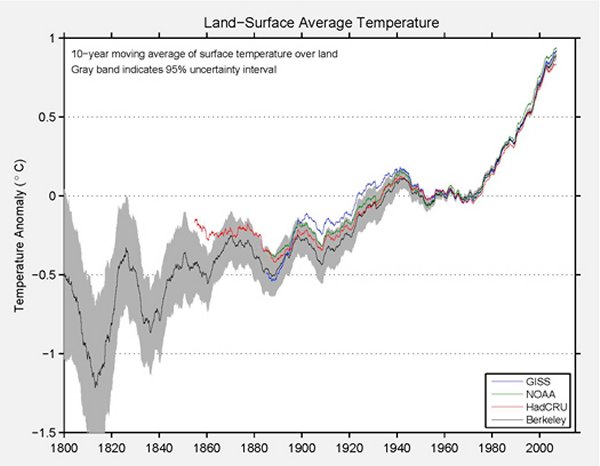
The biggest oversight in most studies of global warming has
been exactly that – the focus has been more on “global” warming
than on “land” warming. The biggest impact of climate
change on civilization will be come from rapid desertification
or “dust bowlification”, which is already beginning
to impact the health and living standards of billions of people
by causing higher food prices. Biofuels are only worsening the
impact of land warming. Of course, there will also be many other
tragic, consequences of climate change, including
polar bears going the way of the mammoth.
The only option is to switch to sustainable, carbon-neutral non-biological
transportation fuels.
Q-52. How can
you be so sure the price of oil won’t
crash again, as it did in 2008?
None of the conditions that allowed the price of oil to crash in 2008 are present
in the world today. The major oil producers now understand this market is extremely
inelastic, and they have the discipline to limit production when necessary. The
Saudis are not investing $200-300B over the next 5 years in oil, gas, and chemicals
production so they can drive the prices down. Rather, they are positioning themselves
to take full advantage of their limited resources over the next 60 years.
Total oil production can continue to increase slowly because of increases in
the “non-conventional oil” – deep water oil, tar sands, GTL,
biofuels, etc. But these very expensive, high-emissions alternative sources cannot
keep pace with the growing demand. The 3 billion people in China, India, Indonesia,
Brazil, and other developing countries without cars can now (or will soon be
able to) buy gasoline-powered cars for $3500. That is a game changer from the
demand side.